The Acton-Boxborough School Committee’s historic vote on January 22 to move to a geography-based school assignment model for elementary families overturned a longstanding practice in place since 1972 that assigned students to an elementary school based on families’ rankings of preferred schools (“open enrollment”).
The vote to discontinue the practice of open enrollment addressed a number of longstanding concerns about the role this model has played in breeding competition between elementary schools in order to attract families and in creating significant demographic imbalances along socio-economic, racial, and ethnic lines that seemed at odds with the district’s commitment to DEI practices.
Opinions on the importance of open enrollment differ widely among stakeholders. A 2024 survey by the consulting firm New Solutions K12 found that while 58 percent of Acton-Boxborough parents and community members indicated open enrollment was either very important or important, 58 percent of Acton-Boxborough school and district staff reported it was not important, with some commenting that the practice emphasizes differences in instructional approaches that have now become ubiquitous across schools and overlooks the district’s gradual but consistent shift since 2017 to a more cohesive approach that includes adoption of common curriculum in core content areas across elementary schools.
Andrew Shen, the district’s deputy superintendent, who oversees implementation of the current open enrollment model opined during the Committee’s January 22 deliberation that “community perception around school choice as an option that is proffered equally to all elementary families is a deeply embedded, false premise in Acton-Boxborough”. Shen explained that “the underbelly of open enrollment is that every year at least twenty-five to thirty percent of incoming elementary families have limited or no options regarding where their child attends school because their first-choice school is full or they moved here after placement decisions have already been made. These students are assigned to schools with lower enrollment in order to balance class sizes.”
This past January, the District brought in consultant Nick Stellitano from the Connecticut-based nonprofit Dillinger Research and Applied Data (RAD) to support the process of building a new geography-based system for assigning elementary students to schools. Stellitano has focused on getting the School Committee and elementary school families up to speed on design elements of a geography-based enrollment model and has designed and implemented robust feedback loops to determine which elements (safe walk zones, sibling priority, balanced class sizes, demographically diverse schools, etc.) are most valued by the community, School Committee, and District leaders.
Examples of some of the feedback loops used to determine priorities include community surveys, ongoing informational and Q&A sessions with parents via webinars, presentations and facilitated discussions with the School Committee at three successive public meetings, and opportunities for stakeholders to engage with interactive maps that delineate the most recent school assignment zone boundaries as scenarios are developed and refined.
Ultimately, the work will culminate in a presentation of final scenarios and a School Committee vote, both scheduled for April 9, which will inform a new set of School Committee policies governing how students are assigned to Acton-Boxborough’s elementary schools and new District-designed procedures detailing how these policies will be implemented.
Local school committees nationwide bear the responsibility for setting policies that determine attendance zones and establish criteria for managing geographic boundaries and balancing enrollment across schools.
What we know so far about the parameters of geographic enrollment
Heading into the April 9 vote, what is endorsed by the Committee at this point is that safe walk zones for families living within a mile from their school, sibling priority, and guaranteed access to the District’s specialized programs for eligible students with disabilities regardless of home address, all of which are encoded in current policy, will continue to be priorities going forward.
The proposed geographic zones also ensure that Acton-Boxborough’s elementary school populations will more closely represent the demographic profile of the communities. Neighborhoods were also analyzed and zoned to schools with an eye toward long term sustainability in order to mitigate the need for redrawing zoning maps.
In the proposed model (scenario 7), Acton-Boxborough will be divided into three school assignment zones with neighborhoods in east and south Acton assigned to the Parker Damon building on Charter Road and neighborhoods in west Acton assigned to the Boardwalk Campus building on Spruce Street. Families can use aninteractive map to identify their assigned school at the neighborhood, street and house levels.
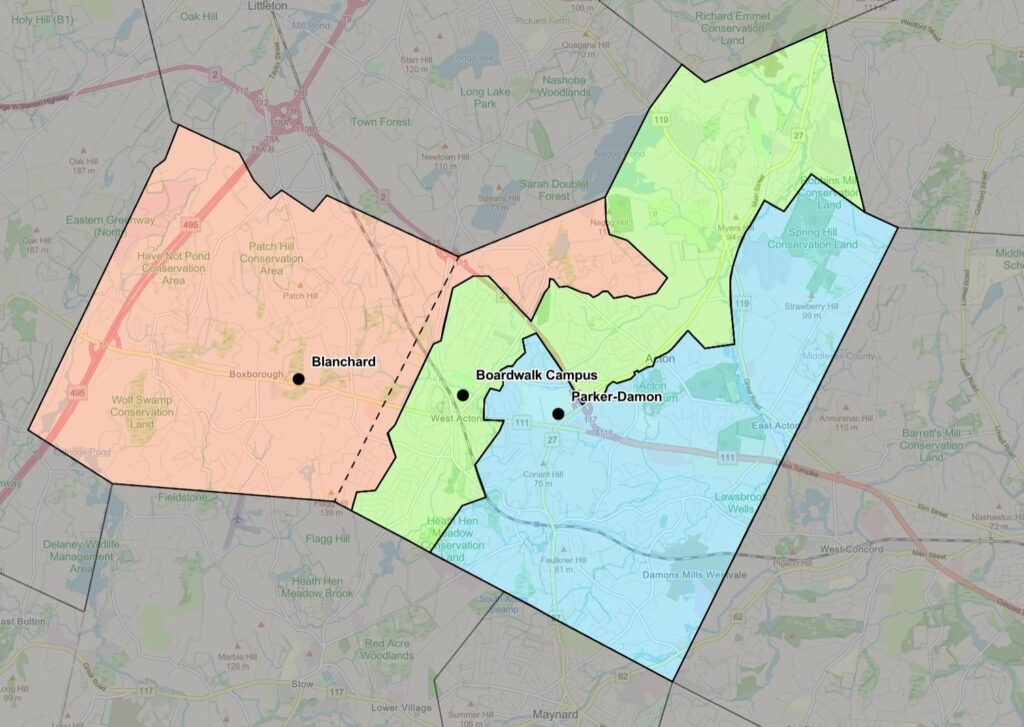
Students residing in Boxborough will be assigned to the Blanchard Memorial Elementary School located in Boxborough which, Stellitano pointed out, creates a problem in that this leaves Blanchard underenrolled at 78 percent utilization and leaves Acton schools over-enrolled with too many students and not enough seats.
At their March 19 business meeting, the School Committee discussed options to solve the problem of this enrollment imbalance which is expected to continue for at least the next three to five years.
One option endorsed by the School Committee is to assign a cluster of neighborhoods centering around Ethan Allen Road in West Acton and a second cluster of neighborhoods in Acton north of Route 2, to Blanchard Elementary School. Deemed “the Blanchard Extended Zone”, these neighborhoods were selected because they are located outside of the one mile walk zone, are in close proximity to the Boxborough Town line, and are more easily accessed by yellow school buses and potentially provide shorter bus rides than other neighborhoods that were considered.
Alternatively, the Committee is considering a transition policy that would legacy Acton students currently attending Blanchard under the open enrollment model, regardless of the neighborhood they live in, to Blanchard for the duration of their elementary career. The 67 students who fall under this category would be joined by current Conant students residing in the Blanchard Extended Zone neighborhoods as well as any new families who move in. Students residing in the Blanchard Extended Zone who currently attend Acton schools would, under the transition policy, also be allowed to remain at their current campus for the duration of their elementary experience.
The Committee also requested more information about the feasibility of a transition policy that would allow rising fifth graders to remain in their current campuses for their sixth and final year of elementary school, a move that is unlikely, due to logistical challenges around yellow bus transportation.
Flex Zones
School Committee discussion on March 19 then turned to identifying parameters that will inform policy pertaining to the use of flex zones which would afford the District an opportunity, triggered by specific, as yet to be determined criteria, to assign entering kindergarteners or students moving into the district and who are residing in designated neighborhoods to one of two designated schools.
Flex zones (also called buffer zones) are used to balance enrollment and maintain demographic diversity across grade levels and schools.
Acton neighborhoods that are currently candidates for receiving the designation “flex zone” include Minuteman Ridge (assigned to the Parker Damon building), and the Ethan Allen and “North of 2” neighborhood clusters in the Blanchard Extended Zone. The Minuteman Ridge and Ethan Allen neighborhood clusters would flex to the Boardwalk Campus and the “North of 2” neighborhood cluster would flex to the Parker Damon Building.
The District leadership and School Committee are expected to finalize parameters on flex zones followed by a final vote by the School Committee at their upcoming meeting on April 9.
Meanwhile, questions in the community have arisen regarding whether or not families in flex zones may be afforded school choice. While, according to Stellitano, this is an option, Committee Member Adam Klein offered a different take on flex zones as follows: “We are not looking for this to be a choice for families. We are looking for this as a relief value if we need to balance class sizes, and those decisions need to be based first on the number of students in a given classroom and second by the needs of students so we are not overburdening any particular school with a certain set of needs. For me that precludes the idea of choice. If I’ve got ten kindergarteners and I need to move five, I want to look at the needs of those kindergarteners and balance the needs and demographics in the school before I give a choice.”
Diane Baum is the School Committee beat reporter for the Acton Exchange.