There is a number every Celtics fan in Acton already knows: 00. It is the jersey number that Robert Parish, known throughout New England simply as “The Chief”, wore during his 14 seasons with the Boston Celtics. That number now hangs in the rafters of TD Garden. And on Tuesday night, Parish himself walked through the door of The Silver Unicorn Bookstore at 12 Spruce Street in West Acton Village to a standing room only crowd.

The occasion was the launch of his new memoir, “The Chief” (Triumph Books), written with Seattle-based journalist Jake Uitti. For fans of Celtics basketball, it was not a bookstore event to sleep on. Parish rarely gives interviews, rarely opens up. The memoir, and the evening, proved to be a genuine exception.

A career unlike any other
Robert Parish played in the NBA for 21 seasons, from 1976 to 1997, a record of endurance almost unmatched in professional basketball history. He is 7 feet 1 inch tall, spent his prime years as the anchor of the Celtics’ dynasty alongside Larry Bird and Kevin McHale, and won four NBA championships: three with Boston (1981, 1984, 1986) and one, improbably, with the Chicago Bulls in 1997, when he became one of the few players Michael Jordan ever had to respect. He was inducted into the Basketball Hall of Fame in 2003 and was named to the NBA’s 75th Anniversary Team in 2021.
None of it, it turns out, was inevitable. Growing up in Shreveport, Louisiana, Parish played baseball, football, and tennis as a boy — but not basketball. He was tall enough to attract a junior high coach’s attention by seventh grade, and reluctant enough that the coach had to practically draft him. He was handed the last jersey left on the rack: No. 00. The rest is Celtic green history.
What the memoir reveals
Parish built a reputation over his career for being famously private, intense on the court, guarded off it. “The Chief” memoir is the first time he has opened up at length about the full arc of his life: his childhood in the South during the uneasy years of integration, his early struggles and development as a player, his years alongside Bird and McHale as part of one of the greatest frontcourts in NBA history, and the bittersweet end of his time in Boston.
He also writes candidly about his one season with the Bulls, where he was one of the few teammates willing to push back when Jordan started talking trash at practice. “He wasn’t accustomed to anyone talking back to him,” Parish writes of Jordan — a line that drew knowing laughs from the crowd Tuesday night. Parish draws sharp comparisons between Jordan’s aggressive, verbal leadership style and Bird’s quieter, lead-by-example approach. Both, he said, shared an almost frightening distaste for losing.
He also writes about a subject that has rarely been discussed publicly: how his time in Boston ended. After the 1993–94 season, the Celtics quietly let him go without a call. The Hornets, who signed him next, were more welcoming. “No one has given me the finger here yet,” he once remarked of Charlotte. He did not hide the sting of how Boston handled his departure.
The book is written with the same honesty, humility, and dry humor that Tuesday night’s audience experienced firsthand. It is, by all accounts, a genuine memoir, not a ghostwritten victory lap, but a real reckoning with a life fully lived.
The evening at The Silver Unicorn Bookstore
The event at The Silver Unicorn, Acton’s independent bookstore, tucked into the heart of West Acton Village, featured Parish in conversation with Gary Washburn, the national basketball writer and columnist for The Boston Globe. Washburn is no stranger to the bookstore circuit himself: he is the author of “Boston Celtics: An Illustrated Timeline” and co-author of “The Spencer Haywood Rule”. The conversation was substantive: two people who know the game deeply, talking honestly about one of its underappreciated legends.
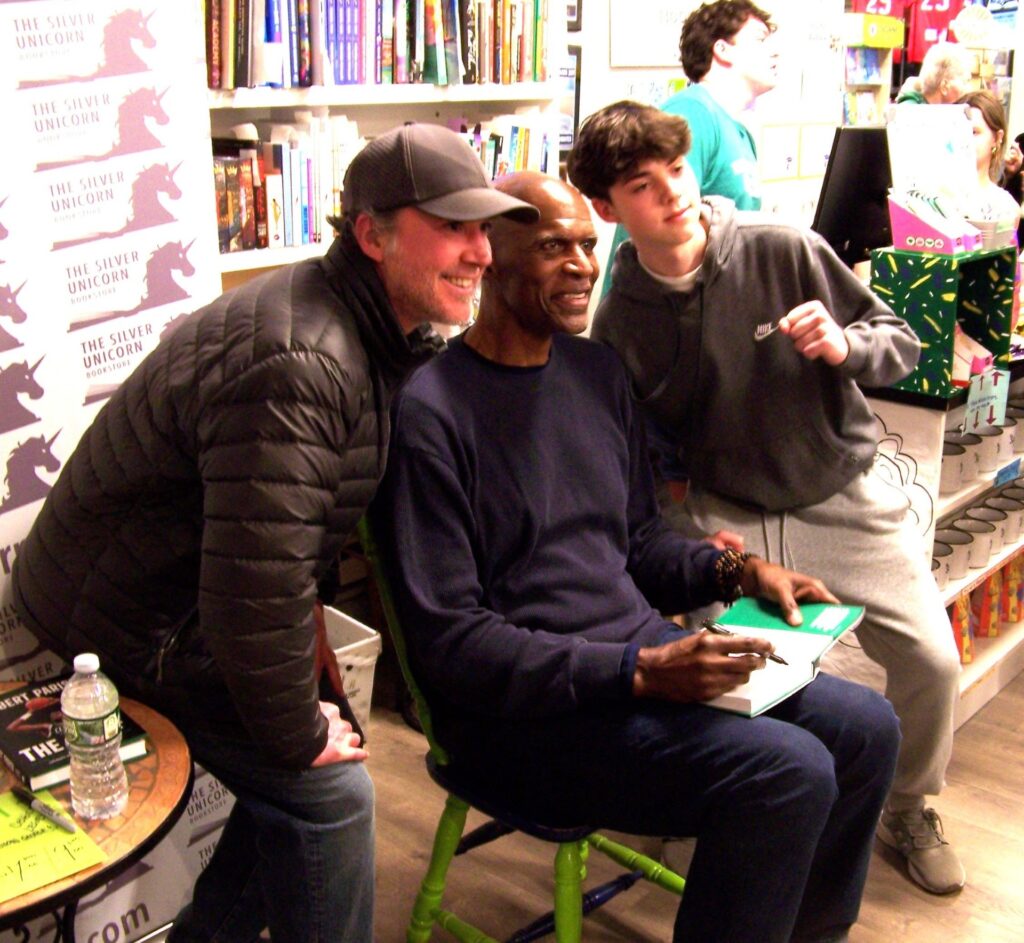
For example, Parish said he was 6’1” tall in 7th grade. And his junior high coach, who was 5’3”, told him, “You are that tall for a reason. Don’t ever give up. You might get your butt kicked but go down swinging.”
By 9th grade, Parish was 7 feet tall, “but I couldn’t catch a pass,” he admitted. Then, he shared the following anecdote: “The first time I caught the basketball, a hush fell over the crowd. Then, someone shouted, ‘He caught it! Double Nothing – 00 – caught it!’ I was so amazed that I almost forgot to turn around and shoot the layup.”
His advice to the crowd in the bookstore: “Be like my Junior High coach. Don’t discourage. Encourage.” Parish reinforced this point later in his conversation with Washburn.
In June 1980, the Golden State Warriors traded Parish to the Boston Celtics along with the 3rd overall pick, which was used to draft Kevin McHale. The Celtics coach was Bill Fitch.
Parish said, “Bill Fitch was all about tough love. If I scored 25 points and made 25 rebounds in a game, Fitch would say, ‘What’s the big deal. We’re paying you to do that.’ He even critiqued us after winning the Championship (in the 1980-81 season).”
This led to a “mutiny against Coach Fitch” at the end of the 1982-83 season. And Red Auerbach, who built the Boston Celtics into one of the greatest dynasties in sports, brought in K.C. Jones as head coach. Parish said simply, “K.C. had people skills.”
After the talk, Parish signed copies of “The Chief” for every member of the standing-room-only crowd. Washburn signed his books as well.
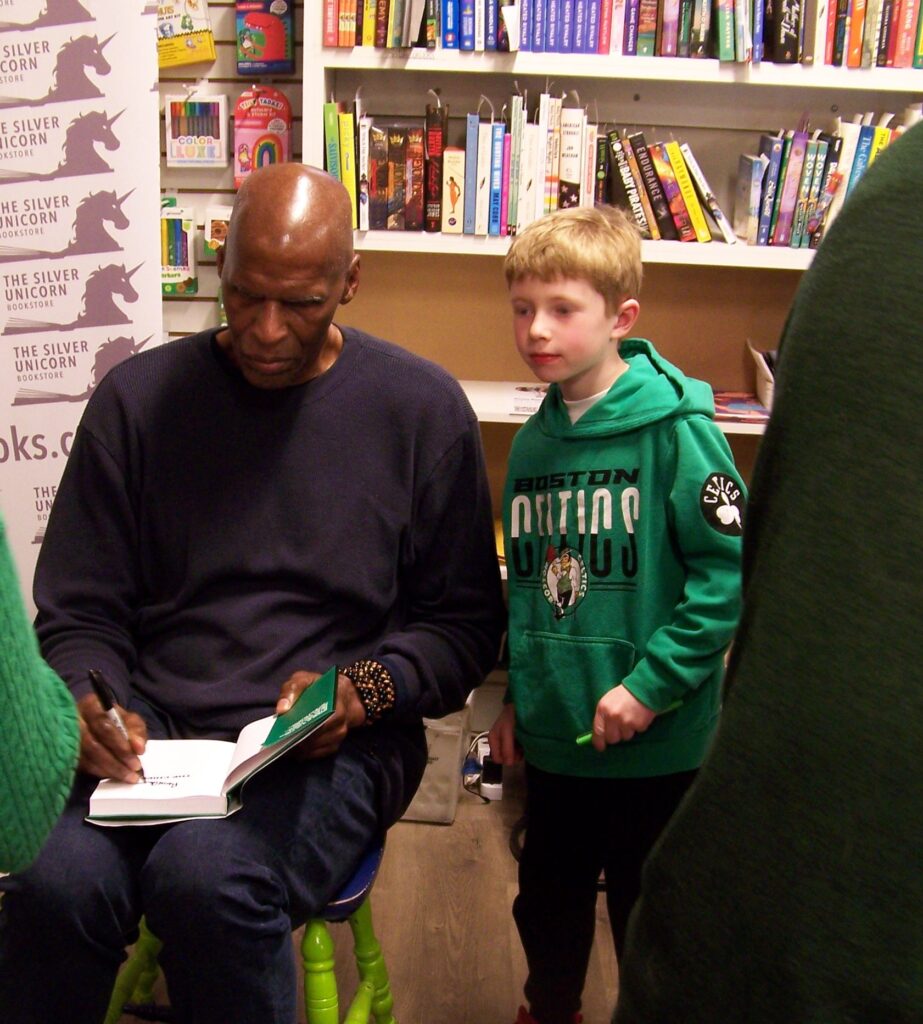
If you missed the evening, signed copies of both The Chief and Washburn’s books are available through the Silver Unicorn’s website. Personalization requests cannot be guaranteed.
Why This Mattered for Acton
In New England, the Celtics are more than a sports franchise, they are a generational thread running through families and neighborhoods. Many Acton residents grew up watching the 1980s Celtics, when Parish, Bird, and McHale were the backbone of a team that won three championships in six years and made the Finals twice more. That era defined what Celtics basketball meant.
Parish was the quietest member of that Big Three — the one who let Bird do the talking and McHale do the showboating, while he anchored the paint with a nine-time All-Star’s consistency. For decades, he had relatively little to say publicly. “The Chief” is his chance to speak, and Tuesday night’s crowd heard him do exactly that.
Robert Parish is 71 years old. He was a professional athlete for 21 years, one of the most durable players in the history of American professional sports. He credits his longevity to discipline: he gave up red meat in 1975, practiced judo for decades, and approached his body with the same quiet seriousness he brought to everything else.
On Tuesday night, he sat in a bookstore in West Acton and told that story. Those who were there won’t forget it.
Greg Jarboe, while nominally the Senior Center beat reporter, writes on various subjects for the Acton Exchange. Our sports beat reporter, James Conboy, contributed to this story.